
Most teams still talk about brand identity as if it were a folder of files: a logo, some colors, a font, and a PDF of rules. That thinking is now a liability. In 2026, identity is a responsive ecosystem — visual, verbal, sonic, and behavioral — designed to prove who you are, not just promote what you sell. It must be legible to people and to machines, and consistent enough to scale without becoming sterile.
Consider what changed. Buyers have become digital detectives: they triangulate claims, expect receipts, and reward brands that show working. AI agents are increasingly researching, filtering, and even purchasing on behalf of customers. Performance marketing’s easy arbitrage has collapsed. What remains is the original growth engine: a clear, credible, and distinctive identity that creates demand, lowers acquisition costs, and compounds trust over time.
This is the era of Resonant Branding — an identity built on clarity and proof of purpose, designed to adapt in real time without losing its center.
What brand identity really means in 2026
Brand identity is not a static visual system. It is the operating system for how your brand shows up — across pixels, spaces, voices, and algorithms. In practice, it’s shaped by three shifts:
Brand as a Citizen (proof over performance). Identity now integrates environmental, social, and governance commitments into the core narrative and behavior, not as a campaign but as an operating standard. Claims require evidence, governance, and ongoing reporting.
Agentic Branding (optimized for AI‑mediated choice). AI agents scan for truth signals. Your identity must be machine‑readable: canonical facts, consistent naming, structured data, and semantic clarity that allow agents to understand and recommend you accurately.
Kinetic Identities (adaptive by design). Logos evolve into responsive SVG “morph‑marks,” type systems flex with context, and motion/sonic cues become primary cues of recognition. The identity adapts to device, environment, and user input without losing recognizability.
Surrounding these shifts are two principles that separate leaders from laggards:
Internal–External Unification. Identity is the strategic spine that connects culture, product, service, and communications. When inside and outside diverge, trust decays — fast.
Radical Simplicity and Semantic Consistency. In automated noise, clarity becomes a moat. Simple, precise language and consistent naming across assets give both people and machines an unambiguous handle on who you are.

Examples point the way: Honda’s frame‑free “Honda 2.0” mark signals an electric future with a cleaner, adaptive symbol; Chantelle Pulp’s variable logotype physically embodies inclusivity; The Atlantic’s modular system balances curation with deep personalization; ASICS reframed performance to include mental resonance; Norwex restructured a complex portfolio into three intelligible pillars; Spotify continues to lead in data‑driven storytelling and live identity adaptation.
Why this matters for growing companies
For high‑growth firms, identity is now an efficiency play as much as an expression play.
Demand creation at lower CAC. A resonant identity increases baseline consideration and conversion before media spend. When meaning and memory are strong, every channel performs better.
Machine‑qualified by default. If your truths aren’t legible to AI agents, you will be invisibly filtered out of shortlists. AIO (AI Optimization) is now hygiene for identity.
Premium positioning, defensible margins. Clarity plus credibility earns price resilience. In luxury, tech, and high‑end services, identity is the signal customers pay for.
De‑risked expansion. Entering new markets (or categories) with an adaptive, unified system prevents message drift across teams, languages, and platforms.
Cultural alignment and delivery. Employees are the fastest way a brand fragments. Unified identity sharpens decision‑making and accelerates execution across sales, product, and marketing.
Proof beats promises. With greenwashing and purpose‑washing easily exposed, the brands that document real‑world impact win the benefit of the doubt — and long‑term loyalty.
Studio Yellow insight: building identities that resonate with humans and algorithms
At Studio Yellow, we don’t treat identity as decoration. We build living systems designed to perform — creatively and commercially.
Evidence‑backed identity. Before design, we inventory proof: outcomes, verifications, governance, and operational practices that substantiate claims. We translate these into narrative, structure, and on‑site modules so every promise has a receipt.
Human + machine legibility. We design for people and for parsers: consistent naming, canonical facts, structured data, and content patterns built for answer engines. AI can scale content; we ensure it scales truth.
Kinetic craft, vector‑first. Morph‑marks, variable typography, and motion as primary identity assets. We design sonic cues and micro‑interactions that travel from mobile to spatial computing.
Inclusive by design. Accessibility, cultural nuance, and multilingual readiness are baked in — aligned with our mission to create work that serves people and planet.
Governance that enables speed. Design tokens, reusable content blocks, and AI guardrails keep teams moving fast without fracturing the brand. We align identity with agile delivery.
Measured resonance. We track share of search, branded query growth, direct traffic, retention signals, and brand lift alongside creative quality — so identity is accountable to growth.
Our perspective is shaped by work with discerning global brands and scale‑ups that expect premium craft and measurable impact. The result is identity systems that look extraordinary — and make the numbers make sense.
Practical steps to implement a resonant brand identity
1) Clarify what you stand for — and gather proof.
- List your top 10 claims (quality, sustainability, speed, security, inclusivity).
- Attach evidence to each: certifications, audited reports, case studies, lifecycle data, testimonials, policies, and KPIs with measurement cadence.
- Decide what you will never claim — the edge of your integrity is part of your identity.
2) Build your semantic foundation.
- Write 25 canonical facts (who, what, where, for whom, how you create value, governance, and impact). Make these consistent across site, socials, PR, and sales.
- Create a message architecture: one positioning statement, three value pillars, and supporting proof points.
- Maintain a source‑of‑truth Q&A document to power AEO (Answer Engine Optimization) and internal enablement.
3) AIO (AI Optimization) hygiene.
- Implement structured data (Organization, Product/Service, Review, FAQ, and Article schemas where relevant).
- Ensure consistent company name, addresses, and leadership across the web.
- Publish high‑clarity About and ESG pages with verifiable references; avoid vague pledges.
- Use canonical URLs, unambiguous slugs, and concise metadata that mirrors your message architecture.
4) Design a morph‑mark and adaptive system.
- Rebuild your logo as responsive SVG with rules for size, contrast, and motion states.
- Choose a variable font family; define ranges for weight/width that adapt by device and content.
- Establish motion primitives (easing, duration, choreography) that express your brand’s personality.
5) Make multisensory core, not garnish.
- Develop a sonic signature (short, distinctive, and scalable) with usage rules.
- Map tactile cues and micro‑interactions for apps, wearable, and spatial contexts.
- Specify motion, sound, and haptic accessibility options to respect neurodiverse users.
6) Unify inside and out.
- Create a brand governance hub: design tokens, component libraries, content patterns, tone-of‑voice guidance, and AI prompts with do/don’t examples.
- Train cross‑functional teams; run enablement sprints with sales, success, and product so identity informs behavior, not just marketing.
7) Operationalize ESG within identity.
- Select 3–5 material impact areas tied to your business model.
- Define targets, reporting cadence, and a public scorecard. Tie creative storytelling to verified progress, not aspirations.
8) Personalize ethically.
- Build a preference center and zero‑party data flow. Be explicit about value exchange.
- Use dynamic content blocks to adapt stories, palettes, and tone based on context — never on sensitive categories. Document your red lines.
9) Run a 90‑day identity pilot.
- Pick one product or market as a lighthouse. Ship the semantic foundation, morph‑mark, and kinetic assets.
- Set three outcome metrics (e.g., branded query growth, conversion lift on direct/organic, and retention signal). Review weekly.
10) Guard against the AI Hollow.
- Keep a human editorial layer for nuance and empathy.
- Train internal models on your style, glossary, and proof library; block auto‑generation on edge cases.
- Require linkable evidence for any claim produced by AI.
11) Measure resonance, not just reach.
- Track: share of search, brand lift on key associations, direct traffic trends, branded query growth, price realization, and retention/expansion health.
- Instrument your website and content to distinguish impact from organic brand demand vs. paid activation.
12) Design for spatial and interactive contexts.
- Prepare lightweight 3D assets and lighting rules for AR/VR.
- Define interaction patterns for wearables and voice/agent interfaces so your brand feels coherent beyond the screen.
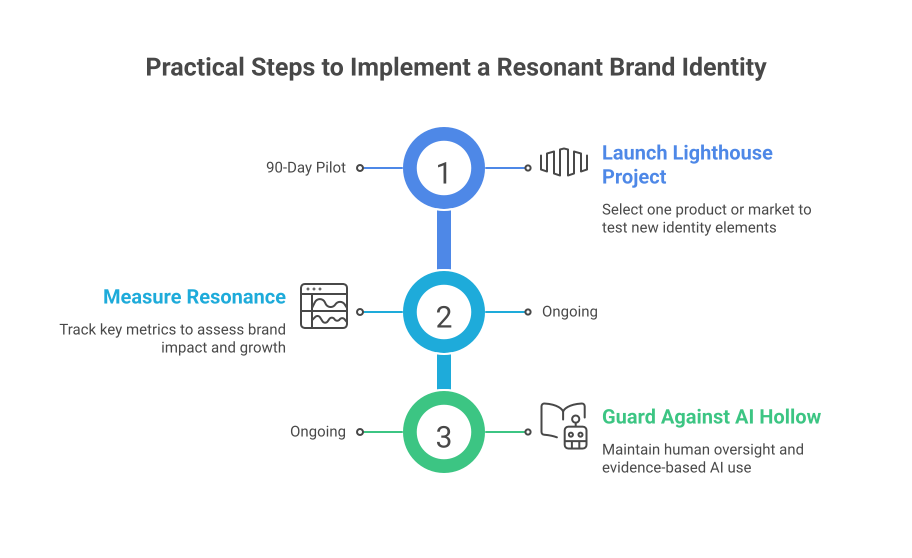
These steps counter the biggest risks today: fragmentation across automated platforms, the “AI Hollow” effect that strips out empathy, and the trust gap created by unsubstantiated claims. When identity is built to adapt — and anchored by evidence — it compounds.
Closing thought
Brand identity in 2026 is a living contract. It signals who you are, proves what you do, and adapts to where your customers are — screens, spaces, and agent interfaces. The companies that win are radically clear, consistently truthful, and crafted for motion.
If you’re ready to elevate identity from a file set to a growth system, Studio Yellow can help you build it — from evidence and semantics to morph‑marks, motion, and governance. When you want the brand you deserve to match the business you’ve built, let’s talk.