Introduction
Branding is no longer only about visuals, messaging, or market positioning. Today, a brand must perform for two audiences: humans and autonomous AI systems that make real decisions on discovery and purchase. The biggest misconception business leaders still hold is that traditional branding efforts will continue to deliver the same returns while AI quietly reshapes how people find, evaluate, and choose brands. That is not the case.
The rise of agentic systems and Answer Engine Optimization, often called AEO, has changed the rules of visibility. By 2026, projections show a sizeable portion of search behavior moving to AI assistants, and more than half of searches already end without a click. For leaders who want to scale with credibility and premium positioning, understanding how branding must evolve to be both emotionally resonant and machine-readable is essential.
What Agentic Branding and AEO Really Mean in 2026
Bold change is happening in three areas that intersect with branding:
Agentic Branding: Brands must be readable by autonomous agents, not only by people. Agentic systems are AI-driven partners that perceive signals, make decisions, and act toward measurable goals, such as launching a recovery campaign when conversion drops.
Answer Engine Optimization: AEO is the practice of structuring content so AI answer engines can trust, extract, and cite it as a direct response. Success is measured by citation frequency and representation in AI overviews, not just blue-link rankings.
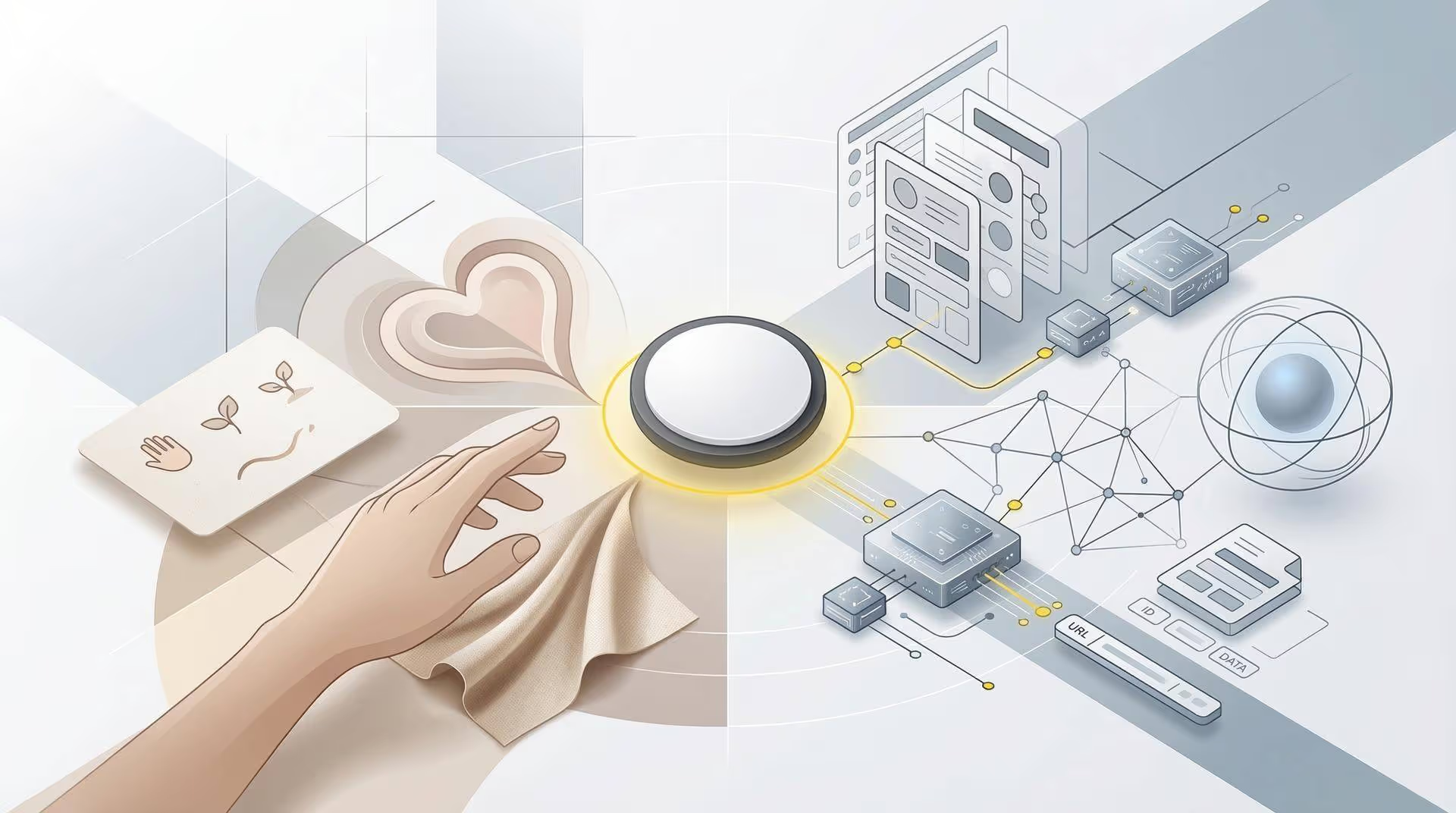
Agentic Lovemarks: The new premium brand objective. A brand must be lovable to people, and legible to machines. Emotional meaning builds loyalty, structural clarity builds discoverability.
Technical signals that determine legibility include advanced schema markup, llms.txt files, mobile-first architecture, and clean content structure. Multi-agent orchestration means specialized agents handle content, analytics, and engagement, forming an autonomous marketing system that adjusts in real time.
Why This Matters for Growing Companies Today
Founders and C-level leaders we work with prioritize three outcomes: credibility, market authority, and measurable growth. Agentic Branding and AEO impact each outcome directly.
Visibility risk: With zero-click search rising, traditional organic traffic can erode if your content is not structured for AI summaries. Being absent from AI answers is digital invisibility.
Speed to action: Agentic systems close the gap between insight and execution, converting signals into campaigns and customer experiences in minutes rather than days.
Competitive advantage: Early adoption of AEO and agentic orchestration creates asymmetric benefits in conversion, trust, and brand perception.
This matters especially for premium and scaling brands that need to "look big" to attract partners and customers. If your brand appears authoritative in AI overviews, prospective customers will assume market leadership before they ever visit your site.
Studio Yellow Insight: How We Treat Branding for the Agentic Era
Studio Yellow does not abandon craftsmanship for automation, nor does it treat AI as a bolt-on tactic. Our approach integrates premium branding with AI legibility and data orchestration, using the studio's core services to create unified, high-impact outcomes.
What we combine for clients:
Brand positioning clarity: We define a concise brand truth that humans feel and machines can parse. Clear positioning reduces ambiguity in AI selection.
Machine-readable architecture: Our web builds prioritize structured data, advanced schema types, and llms.txt implementation, so AI crawlers can discover and trust brand facts.
Unified data and systems: CRM integration, custom systems development, and a clean data layer feed agentic workflows with reliable signals.
Autonomous use cases: We design controlled agentic scenarios, such as cart recovery, dynamic personalization, and bid adjustments, with governance built in.
Measurement aligned to AI visibility: Beyond clicks and impressions, we measure citation frequency, AI-derived traffic, and sentiment in AI overviews.
These elements map directly to our services in branding, web development, AI marketing bots, and marketing automation. The outcome is a brand that retains premium human appeal and consistently appears as an authoritative answer for AI-driven discovery.
Practical Implementation Steps for Leaders
Below is a prioritized roadmap you can use to future-proof your brand for AEO and agentic systems. Each step is operational and aligned with measurable outcomes.
1. Audit for Legibility and Brand Truth
- Inventory your content, structured data, and customer signals.
- Identify fractured data sources and content gaps that cause AI ambiguity.
2. Define a Single Brand Narrative
- Create a concise brand truth and a short set of canonical facts that must appear across the site and feeds.
- Ensure consistency in naming, categories, and product facts.
3. Technical Foundations
- Implement llms.txt and advanced Schema markup (FAQ, HowTo, LocalBusiness, Product).
- Ensure mobile-first performance, clean URLs, and accessible content.
4. Unify Data for Orchestration
- Integrate CRM, analytics, and commerce data into a single layer.
- Build event streams that agents can consume in near real time.
5. Design Agentic Use Cases with Guardrails
- Start small: recovery campaigns, loyalty triggers, or personalized offers.
- Define brand rules, escalation workflows, and human oversight points.
6. Optimize Content for Answers
- Create concise, authoritative answers to high-intent queries, with clear sources and citations.
- Use structured FAQ and HowTo content so AI engines can extract and cite your content.
7. Measure What Matters
- Track citation frequency, visibility in AI Overviews, AI-driven conversion rates, and brand sentiment in generated answers.
- Blend these with traditional KPIs like conversion rate and LTV.
8. Governance and Testing
- Implement synthetic audience testing using agentic simulations before going live.
- Maintain a cadence of monitoring and iterative updates to content and data feeds.
Conclusion
Branding in 2026 requires a dual focus: deep emotional resonance with people, and rigorous structural clarity for autonomous systems. Companies that treat AI as a strategic partner, rather than a toolbox, will capture disproportionate advantage in visibility, trust, and conversion.
If your goal is to elevate brand authority while building systems that act reliably in real time, Studio Yellow helps you bridge creative excellence and technical readiness. Reach out to explore how your brand can become both irresistible to humans and unavoidable to AI agents.
FAQ
1. What is the difference between Agentic Branding and traditional branding?
Agentic Branding adds a technical requirement: legibility to AI agents. Traditional branding centers on human perception. Agentic Branding requires both emotional meaning and machine-readable facts.
2. What is AEO and why is it different from SEO?
AEO focuses on formatting content so answer engines can extract and cite it. SEO optimizes for link rankings. AEO priorities include citation frequency and inclusion in AI overviews.
3. What is llms.txt and should my site have one?
llms.txt is a file that communicates your content preferences to AI crawlers. It helps control how AI agents access and represent your content. For brands aiming for AEO, implementing llms.txt is a recommended technical step.
4. How do I measure visibility in AI answers?
Measure citation frequency, presence in AI overviews, and AI-driven conversion events. Use AEO tools and visibility scores from specialized platforms to benchmark performance.
5. Will agentic systems replace marketing teams?
No. Agentic systems amplify teams by handling repeatable, data-driven tasks. Human teams remain essential for strategy, creative judgment, and governance.
6. How quickly can a brand become legible to AI agents?
With focused effort, technical fixes and structured content can produce measurable results in weeks. Deeper data unification and agentic orchestration are multi-month initiatives.
7. What are the biggest risks of ignoring AEO?
Loss of discoverability in AI-driven channels, misrepresentation by automated answers, and slower reaction to market shifts due to fragmented data.
8. How does Studio Yellow help with agentic readiness?
We combine brand positioning, AI-ready web development, CRM integration, and AI bot creation to make brands both human-first and machine-ready. Our work is iterative, measured, and governed.
9. Do I need to rebuild my website to succeed at AEO?
Not always. Many sites benefit from targeted improvements: schema markup, performance optimization, and structured content. Some brands, especially premium ones, opt for a rebuild to ensure full compliance and performance.
10. What should a budget prioritise for 2026?
Prioritize: brand clarity and content, technical legibility (schema and llms.txt), data unification, and a few high-impact agentic use cases. This sequencing balances cost with quick, demonstrable outcomes.